

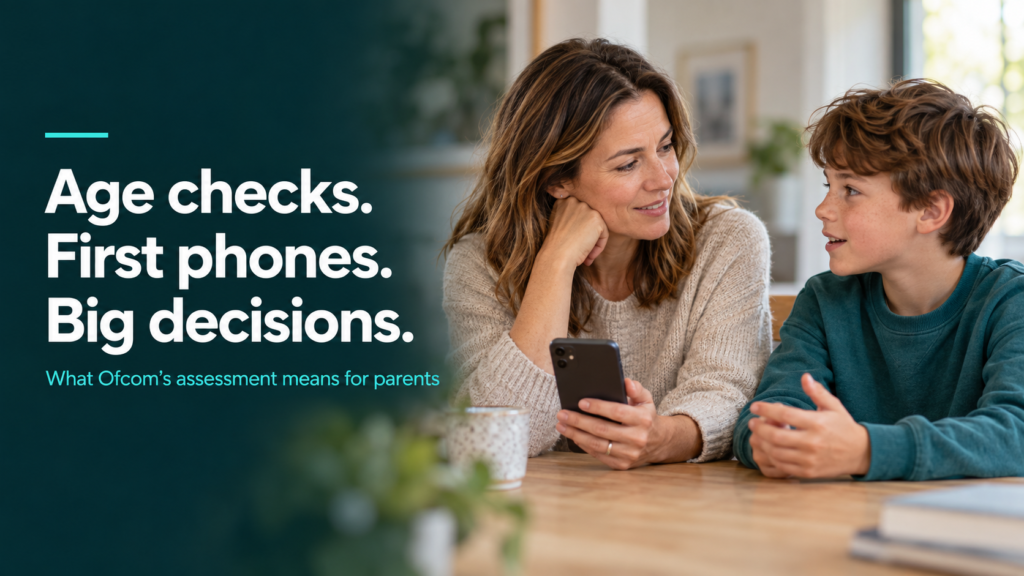
Ofcom’s Age Assurance Assessment
“Can I have a phone?”
For parents of children approaching the end of primary school, it is a familiar question. Behind the answer are several others. Are they ready? What will they be able to access? And if we decide to wait, how will they contact us when plans change?
This month, Ofcom is due to deliver an assessment that will help shape the next stage of the UK’s approach to children and social media. It concerns how platforms establish a user’s age, with implications for families weighing up those questions.
Here is what is due, what it means, and where it fits into the first phone conversation.
What is Ofcom assessing?
Ofcom has committed to delivering a rapid assessment to Parliament by the end of October 2026. It will examine how highly effective age checks could work in practice to determine whether someone is over 16.
“Age assurance” is the term for methods used to establish or estimate someone’s age. The practical challenge is making an age limit work when a person opens a website or joins an app.
The assessment will inform debate around the Government’s planned restrictions on social media access for under-16s. Ofcom has confirmed the end of October deadline, although we have not found a specific publication day.
You can read Ofcom’s explanation of the assessment here.
Does anything change immediately?
Publication of the assessment will not itself bring the planned restrictions into force.
The Government’s published response on children’s online safety says it intends to lay the first regulations before Parliament by the end of 2026, with restrictions on social media services offering their services to under-16s expected in spring 2027.
Those are planned timings. Families should look for the final rules and implementation details as the process develops.
The October assessment is also separate from Ofcom’s broader report on existing age-assurance practices, published in July.
What will make age checks useful?
Ofcom has already highlighted the difficulty of stopping people getting around age checks. It sees a role for protections across services, app stores, operating systems and devices.
There is also a practical difference between checking adulthood and checking an age threshold of 16. Credit-card checks, for example, will not work for 16 and 17-year-olds.
For parents, our view is that the eventual arrangements need to be understandable as well as effective. Families should be able to see what information a check needs, how it is handled and what happens when the system gets someone’s age wrong.
An age check is one part of building an online environment parents can trust.
Where does this leave the first phone decision?
The assessment concerns access to online services. It does not set an age at which a child should own a smartphone.
That leaves families with a personal decision, shaped by their child’s needs and circumstances.
In our earlier post on the first phone debate, we explored the reasons behind that purchase. Being able to contact a parent is often central to the decision.
For families with children aged 8–11, an everyday change of plan can bring that concern into focus. A club finishes early. A collection arrangement becomes confusing. A child is with another family and wants to contact someone they trust.
Parents considering delaying a first phone need a clear plan for those moments. Parents whose children already have one need a plan for a flat battery, a lost phone or a device left at home.
A way to connect from any smartphone
My Home Call gives a registered child a way to connect with a saved trusted contact from any smartphone, using their name and a facial scan.
A parent or guardian sets up the child’s profile in advance and chooses their trusted contact. When needed, the child opens My Home Call on a borrowed smartphone, identifies themselves and can make a short call or send a pre-written message. Messages include their what3words location.
There are no passwords, no numbers to remember and no app to download on the borrowed phone.
Through Always a Way Home, the free account includes one trusted contact, calling, messaging and what3words location sharing. Paid options allow additional trusted contacts.
It needs an available smartphone with an internet connection. Practising together, and agreeing who your child can ask for help, makes it part of a plan they understand.
A useful conversation to have now
Ofcom’s assessment will help clarify how age restrictions could operate. While that work continues, families can talk about what their child needs today, what access they are ready for, and how they would contact a trusted person if something changed.
Our view is that parents should feel supported in making those decisions at their own pace. A practical way to stay in touch can help make that possible.
Thinking about delaying your child’s first phone? Find out how Always a Way Home works and set up their free account.