

The EU Entry Exit System With Children: What Happens at the Border This Summer
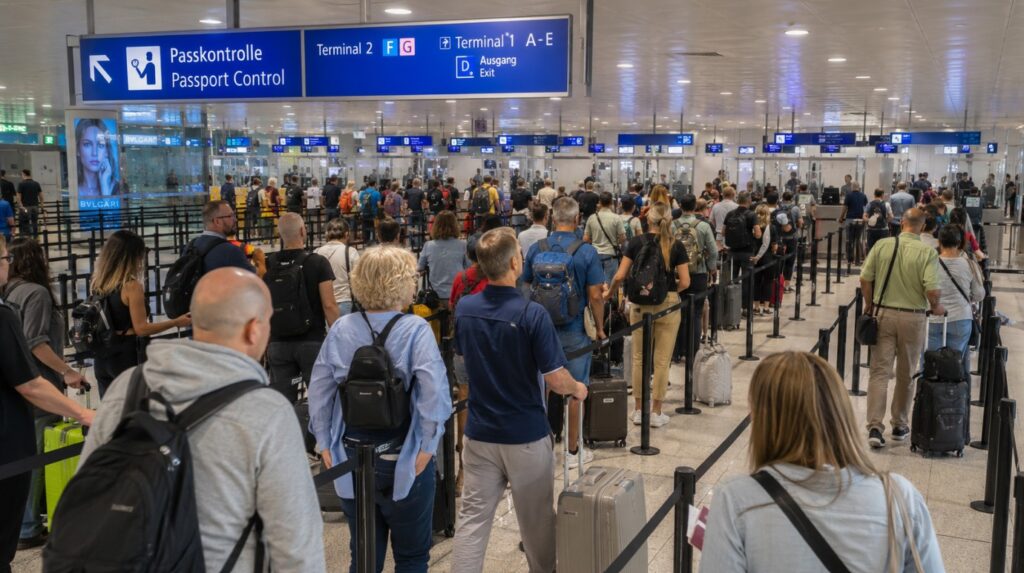
Every family holiday has a queue in it somewhere. This year, the one at passport control is doing something new. Travelling through the EU entry exit system with children is not complicated, but it is different from anything British families have done before, and it is much easier if you know what is coming before you are standing in it with three suitcases and a tired seven year old.
The system has been live in some form since October 2025 and became fully operational across participating European countries on 10 April 2026. This summer is the first proper school holiday it has had to handle.
What Has Actually Changed at the Border
The Entry/Exit System, usually shortened to EES, replaces the old passport stamp with a digital record. Instead of an officer marking your passport, the border now registers who you are, when you arrived and when you left, and it holds that alongside biometric data.
For most adult travellers, that means a facial image and four fingerprints on your first crossing. On later trips, the border checks you against the record already held. The information is normally erased three years after your last trip to a participating country. The House of Commons Library briefing sets out the detail, and ABTA keeps a practical summary for travellers.
It applies almost everywhere UK families go: most of the EU plus Norway, Iceland, Switzerland and Liechtenstein. Ireland and Cyprus are outside it.
What About ETIAS?
ETIAS is a separate thing, and it is not here yet. It is a pre travel authorisation, closer in spirit to the American ESTA. The EU has been targeting the end of 2026, but no date has been confirmed and there have been reports that it may slip into 2027.
The important point for this summer: you cannot apply for it, and you do not need it. If a website offers to sell you one now, it is not an official service.
The EU Entry Exit System With Children: What to Expect
Children are not exempt. Everyone in the family goes through the checks, but the process is slightly different depending on age.
- Children under 12 do not have their fingerprints taken. They do still have a facial image captured, and their passport details recorded.
- Children aged 12 and over are treated the same as adults, with a facial image and fingerprints on the first crossing.
- Every child needs their own valid passport, as before.
That is worth explaining to a child in advance, in plain terms, because the moment itself can feel strange. A stranger in uniform will ask them to look straight at a camera, and they may be asked to take off a hat or push a hood back. Told beforehand, it is a photo. Sprung on them at the end of a long flight, it can feel like being in trouble for something.
Keep it short and accurate. Somebody will look at your passport and ask you to look at a camera, just like the photo we took for it. That is all it takes.
Why the Queues Are Longer This Summer
The first registration is the slow part, and this July almost everybody is doing their first registration. Airports and airlines have not been quiet about the strain. In early July, the airport body ACI EUROPE, Airlines for Europe and IATA wrote jointly to the European Commission warning that the rollout was causing serious disruption at many airports.
In practice, that means allowing considerably more time than you would have done two years ago, at both ends of the trip. Border checks on the way home count too. It also means the family is going to be standing in a hall, together but strung out along a queue, for longer than usual. Which brings us to the part of this that is genuinely worth planning for.
Two Kinds of Facial Recognition, in One Summer
There is a strange thing happening to British families this year. Many parents who would describe themselves as uneasy about facial recognition will hand over a facial image at a border in August without really being asked. We wrote about that tension a few weeks ago in the same face, two different stories, and it is worth saying plainly here.
The technology is not the thing that decides whether it is reassuring or unsettling. Consent is. A border system records you because you are crossing a border, and you cannot decline and still get to Spain. That is a legitimate use, run under strict rules, and it is also not a choice.
What we build is the other kind. A child’s face is used to confirm that they are who they say they are, so they can reach someone who loves them. It is set up by a parent, at home, in advance. Nothing happens unless the child starts it. And no image of their face is ever stored, only a non reversible code. We set out the difference in full in our piece on consensual biometrics versus surveillance.
Same underlying idea. Completely different relationship with the person it is pointed at.
The Part That Happens After the Border
Once you are through, the risk changes shape. The airport hall, the transfer coach, the resort, the beach, the market on the last afternoon. Families spread out. And nearly every safety habit we all rely on abroad quietly depends on one thing: a phone with charge in it, in the right hand.
Phones go flat faster on holiday than anywhere else, because they are doing maps, boarding passes, photographs and translation all day in the heat. Phones also get left in taxis, dropped in pools and lifted in crowds. When one goes, it takes the contact list, the hotel address and the booking references with it in a single moment. We looked at what that feels like at home in the blue dot goes out. Abroad, with no wifi, a language barrier and no idea of the address you are staying at, it is the same problem with the volume turned up.
A separated child at a meeting point is only as safe as the adults they can actually reach.
Where My Home Call Fits
My Home Call is a UK built biometric safety platform, designed for exactly this gap. A child can reach a saved trusted adult from any borrowed smartphone, using their name and their face. No app to download on that phone, no password, no numbers to remember, and their trusted contact’s personal number is never shown.
Through our Always a Way Home campaign, a free account with one trusted contact is available to every child in the UK. Messaging, calling and what3words location sharing are included, which matters more than usual abroad: a precise three word location is far more useful to a worried parent than a child trying to describe a street name they cannot pronounce.
Setting it up takes a few minutes at the kitchen table, and it is worth doing before you leave rather than after something has gone wrong. You can see the whole process on our how it works page.
A Short Checklist Before You Fly
- Check FCDO travel advice for your destination, and that every passport, including the children’s, is valid for the trip
- Add a good hour to what you used to allow at passport control, going out and coming home
- Explain the camera step to younger children before you reach the desk
- Agree a meeting point at every new place, and take a photo of the children each morning
- Set up a free My Home Call account for each child and add their trusted contact, so a lost or flat phone does not cut them off
- Ignore any site offering to sell you an ETIAS
Most of these take five minutes. Our fuller guide to family travel safety covers the rest.
The border will take a picture of your family this summer whether you have thought about it or not. The question worth asking is a different one: if a phone goes flat in a strange city, can your child still reach you?
Set up your child’s free account before you travel
About My Home Call
My Home Call is a UK built biometric safety platform. Any registered My Home Call account holder on a free or paid plan can reach their saved contacts from any borrowed device, without needing their own phone, without remembering numbers, and without exposing personal contact details.
Because it works from any device, anywhere, My Home Call is just as valuable away from home as it is in the school day. If a child’s phone is lost, flat, forgotten or stolen at the airport, on a school trip, on a day out, or simply walking home, they can still reach a parent or trusted adult securely from any phone or tablet they can borrow.
Get in touch to learn how My Home Call keeps your family connected: hello@myhomecall.com