

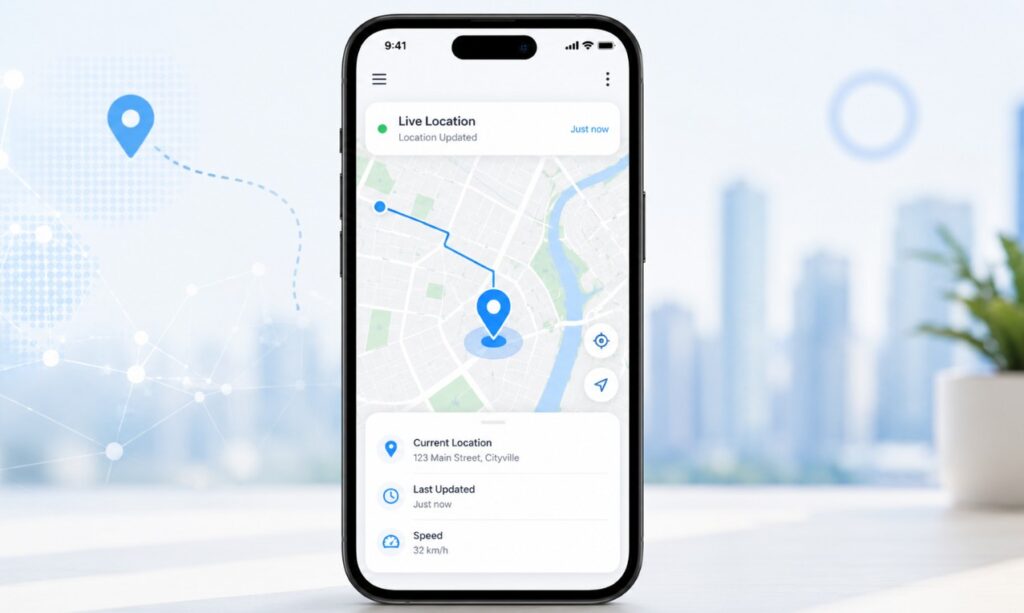
Tracking Apps Track the Phone, Not the Person
Open the app store and search for family safety, and you will find the same idea over and over: a map, a moving dot, and the reassurance of knowing where your people are.
Location tracking has become one of the most common ways families look out for one another. And it is easy to see why. A glance at a screen tells you your child has arrived at school, that an elderly parent is home safely, or that someone you love made it to where they were going.
We think tracking apps are genuinely useful. But they have one limitation that is rarely talked about, and it matters most in exactly the moments you would want them to work.
Tracking Has a Real and Valuable Place
Let us be clear from the start. This is not an argument against tracking apps. Used well, they are a sensible and caring tool.
Most people who use them are doing so from a place of safety, not control. A parent keeping a quiet eye on a teenager’s journey home. A family staying aware of an elderly relative who lives alone. An adult who has agreed to share their location with a partner so that someone always knows where they are.
There is nothing sinister about any of that. For a great deal of everyday life, a shared location gives real peace of mind, and it can genuinely help in an emergency. Tracking earns its place in the safety toolkit.
The point we want to make is not that tracking is wrong. It is that tracking, on its own, is not the whole answer.
The Detail That Changes Everything
Here is the thing that is easy to miss. A tracking app does not follow a person. It follows a phone.
Nine times out of ten, that distinction does not matter, because the phone and the person are in the same place. The dot on the map is where your child is, because your child’s phone is in your child’s pocket.
But safety is not about the nine times out of ten. It is about the one time in ten. And the one time in ten is precisely when the phone and the person are no longer together.
- The phone is lost or left behind on a bus or in a changing room
- The battery goes flat partway through the day
- The phone is stolen, often the first thing to happen if someone is in trouble
- The phone is somewhere the person is not allowed to take it, such as a phone free school
In every one of these situations, the tracker keeps showing you a location. But it is the location of a device, not the location of the person you care about. The map looks reassuring while telling you nothing useful at all.
Worse, it works in one direction only. A tracker lets you see a dot. It does not give the person at the other end any way to reach you. If your child’s phone is gone, they cannot tap the map and call for help. They are standing somewhere, perhaps frightened, perhaps lost, with no way to make contact, while you look at a dot that has not moved for an hour.
Belt and Braces
Good safety is rarely built on a single tool. It is built in layers, so that when one thing fails, another is there to catch the gap.
Tracking is an excellent first layer. It covers the ordinary, everyday reassurance of knowing where your people are, and it does that job well. The question worth asking is simply this: what is the second layer? What happens in the moment the first layer cannot cover, when the device is lost, flat, or gone? It is the same question worth weighing when you decide on a child’s first phone: what is the plan for when the chosen device fails?
That is the gap. Not a flaw in tracking, but the natural edge of what tracking can do. And it is a gap that has, until recently, had no good answer. If the phone was gone, you were simply out of options.
The Final Link in the Chain
This is where My Home Call fits. Not as a replacement for tracking, but as the layer that covers the moment tracking cannot.
My Home Call is a biometric safety platform. It lets a registered account holder reach their saved contacts from any borrowed device, by identifying themselves with a quick facial scan. No personal phone required, no numbers to remember, no app for the borrowed device. The message is sent as a text straight to their trusted contact’s mobile.
In other words, it is built around the person, not the device. So when the device fails, the person is still covered. A child whose phone has been lost or stolen can borrow a phone from a friend, a teacher, or a passer-by, prove who they are, and reach home in seconds. The very situation that defeats a tracker is the situation My Home Call was made for.
Used together, the two complement each other neatly. Tracking gives you the everyday picture. My Home Call gives the individual a voice when that picture goes dark. One watches the device. The other belongs to the person.
Safety That Reaches the Last One Percent
If tracking covers ninety-nine percent of ordinary days, the value of a second layer is that it reaches the final one percent: the lost phone, the flat battery, the stolen handset, the day the device is simply not there.
That final one percent is small in frequency and enormous in importance. It is, almost by definition, the moment a family most needs to be connected and is least able to be.
So keep using your tracking app. It is a good tool, and it does a real job. Just do not mistake it for the whole of safety. The most reassuring thing is not only knowing where a phone is. It is knowing that whatever happens to the phone, the person can always reach you.
Tracking Apps and Family Safety: Questions People Ask
Do tracking apps work if the phone is lost or stolen?
Not for finding the person. A tracking app follows the phone, so if the phone is lost, stolen, flat or left behind, the map shows where the device is, not where the person is. That is the one moment you most need it, and the moment it cannot help.
Are family tracking apps a good idea?
Used well, yes. They give real, everyday peace of mind and can genuinely help in an emergency. The limitation is simply that they cover the device, not the person, so the sensible approach is to pair them with a way for the person to make contact when the device is not there.
What is the best backup for a family tracking app?
A second layer that belongs to the person rather than the phone. My Home Call lets a registered child or adult reach their saved contacts from any borrowed device, so a lost, stolen or flat phone no longer leaves them stranded.
About My Home Call
My Home Call is a UK-built biometric safety platform. Any registered account holder, on a free or paid plan, can reach their saved contacts from any borrowed device, without needing their own phone, without remembering numbers, and without exposing personal contact details. Messages are sent as a text directly to the contact’s mobile, so there is no app for the person receiving the message to download.
It works wherever another device is within reach, giving children and families a secure way to reach home when their own phone is lost, flat, forgotten, or simply not allowed.