

The Hidden Cost of a School Phone Policy
When a school introduces a mobile phone policy, the costs that get signed off are the obvious ones. Pouches, lockable wallets, lockers, and a line in the budget for replacing them each year. Those costs are planned, approved and understood.
The cost that never makes it into the business case is the one that arrives quietly every morning and never leaves. It is staff time, and over a school year it adds up to far more than the hardware ever will.
What Costs Does a School Phone Policy Actually Have?
A phone policy has two kinds of cost. The first is visible and budgeted: the physical kit that stores or locks away devices, plus the annual replacements for each new Year 7 cohort. We broke that side down in detail in the true cost of phone free schools, and for most secondary schools it is a known, finite number.
The second kind of cost is invisible, and it is the one this article is about. It does not appear on an invoice. It shows up as hours, spread across the people who can least afford to lose them.
The Cost Nobody Budgeted For
Every phone free school still has to answer one simple question. If a child cannot use a phone during the day, how do they reach home?
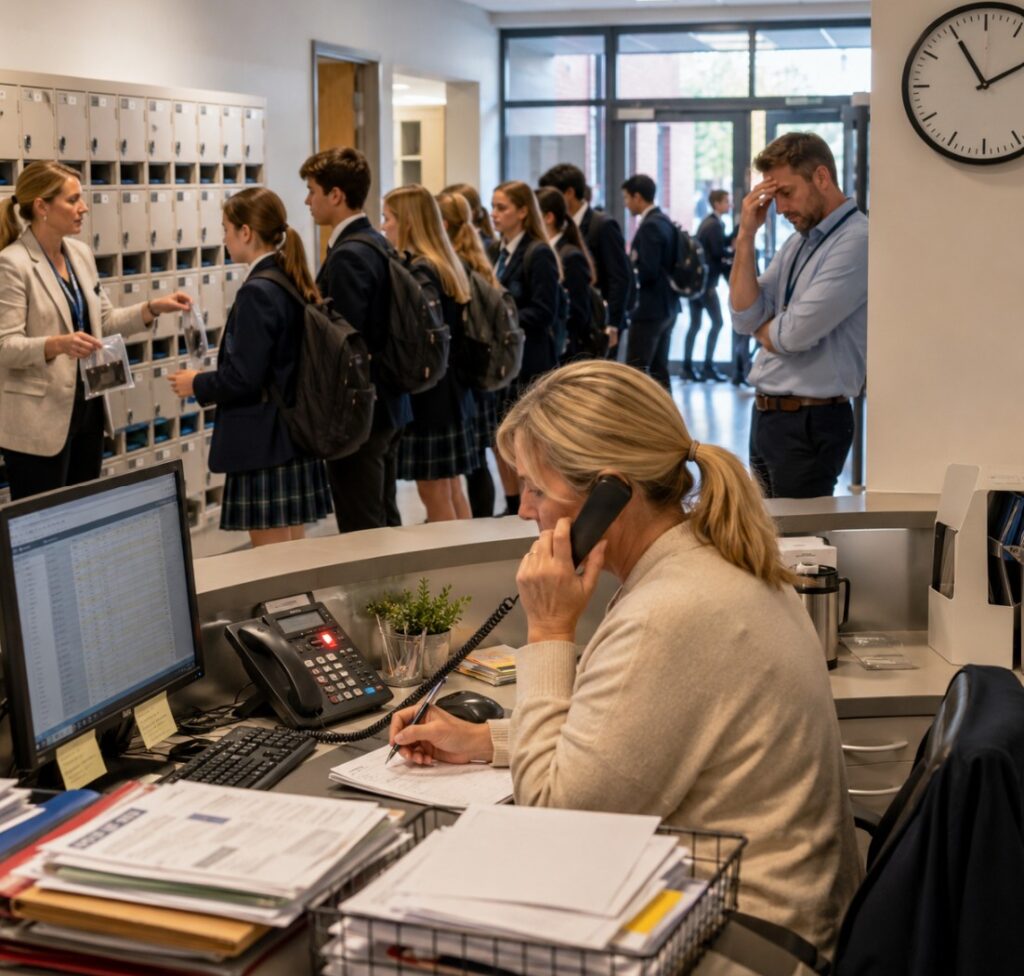
When the phones go into the pouch, that need does not disappear. It simply gets redirected to the one part of the school that cannot lock itself away: the front office, and the heads of house and pastoral staff standing behind it.
The result is a steady stream of small interruptions that, added together, consume a remarkable amount of skilled time. A 2026 University of Birmingham study, published in BMJ Mental Health, found that schools with restrictive phone policies spend an average of 102 hours a week implementing them, the equivalent of 3.1 full time members of staff. Some of that is enforcement. A large and avoidable share of it is the quieter work of relaying messages between home and the classroom.
A Day at the Front Desk
Picture a typical school office on a typical day. The queue and the phone line fill with the same handful of everyday situations:
- A forgotten PE kit that needs dropping off
- A lunch money top up
- A change to who is collecting at the end of the day
- A missed bus
- A detention that shifts the pick-up time
- A child running late and needing to let home know
Each one is tiny. None of them is an emergency. But across hundreds of students, day after day, they turn the office into something it was never meant to be: a student secretary, taking messages, phoning parents, carrying notes to classrooms and chasing confirmations.
What Could Heads of House Be Doing Instead?
This is where the real cost lands. Heads of house, pastoral leads and office staff are skilled, experienced and already stretched thin. Every hour spent passing on “please bring my kit” is an hour not spent on the work that only they can do.
That work is the heart of the role:
- Pastoral conversations with students who are struggling
- Safeguarding follow up that genuinely cannot wait
- Attendance and the families behind the numbers
- Settling anxious students and being present in the corridor
The unforeseen cost of a phone policy, then, is not really about money at all. It is the slow conversion of trained pastoral professionals into a manual message service, one interruption at a time.
What Does the Research Say About Phone Bans?
The evidence points in the same direction. In 2025, a University of Birmingham study known as SMART Schools, published in The Lancet Regional Health Europe, compared 1,227 students across 30 secondary schools. It found that banning phones during the school day was not, on its own, linked to better mental wellbeing, lower anxiety or depression, improved sleep, more physical activity, or higher attainment in English and Maths.
The researchers were clear that this is not an argument against phone policies. Their point was that a ban in isolation is not enough, and that what matters is the wider approach around it. Part of that wider approach is how a school handles a child’s genuine need to stay in touch with home. A policy that removes phones but leaves everyday communication unsolved does not remove the work. It simply moves it from the pupil’s pocket to the school office.
That is the difference between a policy that looks good on paper and one that works in the corridor, and it is exactly the gap the right infrastructure is meant to close.
Where My Home Call Fits
My Home Call is a biometric safety platform that sits alongside your existing pouches and lockers rather than replacing them. The policy stays exactly as you have designed it. What changes is the admin behind it.
Instead of routing every routine message through the office, students use a secure kiosk to contact home directly. They type their name, complete a quick facial scan to confirm who they are, and send a short pre-set message such as “I forgot my PE kit”, “Please top up my lunch money” or “I am running late”. The parent receives it, no personal numbers are ever shown, and no member of staff has to sit in the middle. You can see the full process on our how it works page.
The everyday traffic that used to land on the front desk now handles itself. The pouches still do their job. The office gets its day back.
Giving the Office Its Day Back
The schools that make phone free policies work for the long term are the ones that plan for the message traffic, not just the phones themselves. Storing devices is the easy part. Handling the hundred small contacts those devices used to carry is the part that quietly costs you a member of staff.
Put the right infrastructure behind your policy and that cost disappears. Your pastoral team goes back to being a pastoral team, and your office stops being a student secretary.
School Phone Policy Costs: Questions School Leaders Ask
How much does a school phone policy cost in staff time?
A 2026 University of Birmingham study in BMJ Mental Health found that schools with restrictive phone policies spend an average of 102 hours a week implementing them, the equivalent of 3.1 full time members of staff. A large and avoidable share of that is the work of relaying everyday messages between home and the classroom.
Do phone bans on their own improve pupil wellbeing?
Not on their own. The 2025 SMART Schools study in The Lancet Regional Health Europe compared 1,227 pupils across 30 secondary schools and found that a ban alone was not linked to better wellbeing, sleep, activity or attainment. What matters is the wider approach around it, including how a school handles a child’s need to reach home.
How do pupils contact home in a phone free school without using the office?
A secure kiosk lets pupils contact home directly. They enter their name, complete a facial scan to confirm who they are, and send a short pre-set message. The parent receives it, no personal numbers are shown, and no member of staff sits in the middle, so the message traffic stays off the front desk.
About My Home Call
My Home Call is a UK built biometric safety platform. Any registered My Home Call account holder on a free or paid plan can reach their saved contacts from any borrowed device, without needing their own phone, without remembering numbers, and without exposing personal contact details.
Because it works from any device, anywhere, My Home Call lends itself naturally to phone free schools. But it is just as valuable outside the school gates: if a child’s phone is lost, flat, forgotten or stolen at the bus stop, on a school trip, on a day out, or simply walking home, they can still reach a parent or trusted adult securely from any phone or tablet they can borrow.
To discuss how My Home Call could fit into your school or trust, contact hello@myhomecall.com