

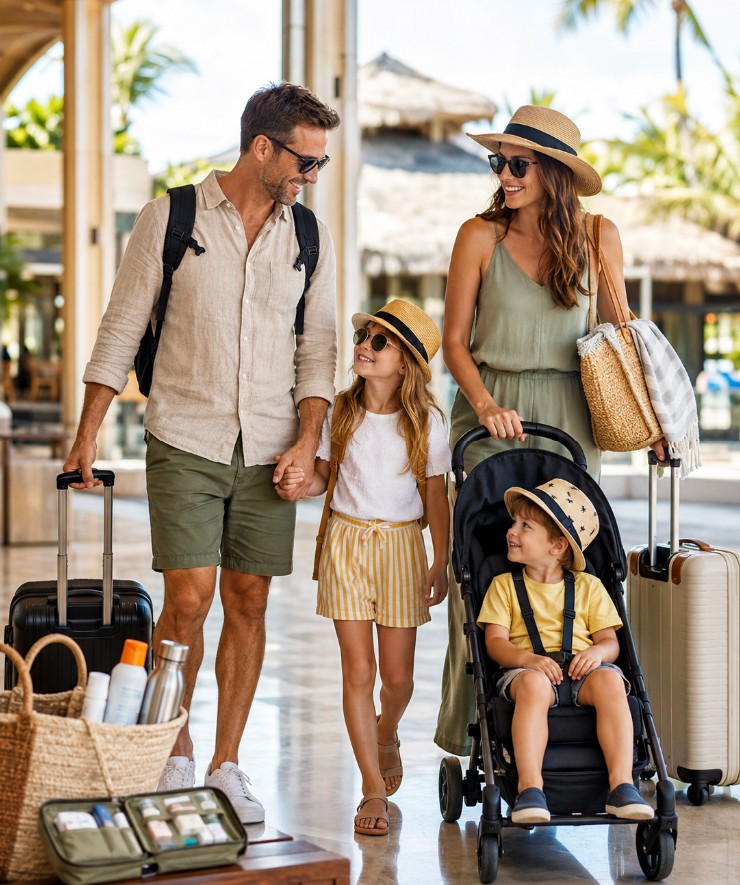
Family Travel Safety Tips for Summer
Summer is the season of departure lounges, motorway service stations and that first proper exhale when the holiday finally begins. It is also the time of year when families are most spread out, most reliant on a single phone, and most likely to hit the small problems that turn a relaxed trip into a stressful one. A child wanders a few feet too far at a busy attraction. A bag goes missing with a phone inside it. A battery dies at the worst possible moment, in an unfamiliar place, with no charger to hand.
Most of these moments pass without harm. What makes them frightening is rarely the event itself. It is the gap that opens up in the seconds afterwards, when you cannot reach each other and nobody is quite sure what to do next. The good news is that this gap is the easiest part of a trip to plan for, and it takes only a few minutes before you leave.
Start With the Basics, Before You Pack
A safe trip begins with a little preparation at the kitchen table. Before you travel, it is worth checking the official FCDO foreign travel advice for your destination, making sure passports and travel insurance are in order, and applying for or renewing a Global Health Insurance Card if you are heading into Europe. If you have booked through an operator, keep your ABTA or travel representative details somewhere you can find them quickly.
Then there are the simple family habits that have always worked:
- Agree a meeting point at every new place you visit, so that if anyone gets separated, everybody already knows where to go
- Take a photo of the children each morning, so you have an up to date picture of what they are wearing
- Talk through, in calm and age appropriate terms, what each child should do if they cannot find you
The One Thing Most Families Forget to Plan For
Here is the part that catches people out. Almost every modern safety habit, from a shared location app to a quick call home, depends on one fragile thing: a charged phone that is actually in someone’s hand. We have written before about how few children now memorise a phone number, and on holiday that quiet dependence becomes a real risk.
A phone can be lost in a pool bag, left in a taxi, drained flat by a day of photos and maps, or simply taken in a crowd. The moment it is gone, so is the contact list, the booking confirmations, the emergency numbers and the way home. A separated child standing at a meeting point is only safe if the adults can actually be reached, and a teenager who has lost their phone abroad has lost their entire address book in one go.
Where My Home Call Fits
My Home Call is a biometric safety platform, and this is exactly the situation it is designed for. It gives every member of the family a secure way to identify themselves and reach their trusted contacts from any smartphone, even if their own phone is lost, stolen, damaged or out of battery. You can read the full explanation on our how it works page, but the idea is simple. Your important contacts live safely in one place, ready to reach from a borrowed handset, a hotel desk or someone else’s phone in a genuine emergency.
Setting it up takes three steps and only a few minutes:
- Register before you travel. Create a free account at home, well before you reach the airport.
- Add your trusted contacts. Save family, friends, your travel representative, your hotel and your travel insurance emergency number, so the people who matter are reachable in one tap.
- Use any phone if needed. If a phone is lost or flat, each traveller can still identify themselves and make contact from another smartphone.
It works for the whole family, from younger travellers to teenagers heading off more independently, and it sits quietly in the background until the day you actually need it. We covered the wider thinking behind staying reachable in busy places in our guide to planning ahead for a stress free day out, and the same principle applies abroad, only with higher stakes.
Download the Free Travel Guide
To make this easy to share with the whole family, we have put the steps onto a single page you can save or print before you go.
Download the My Home Call travel safety guide
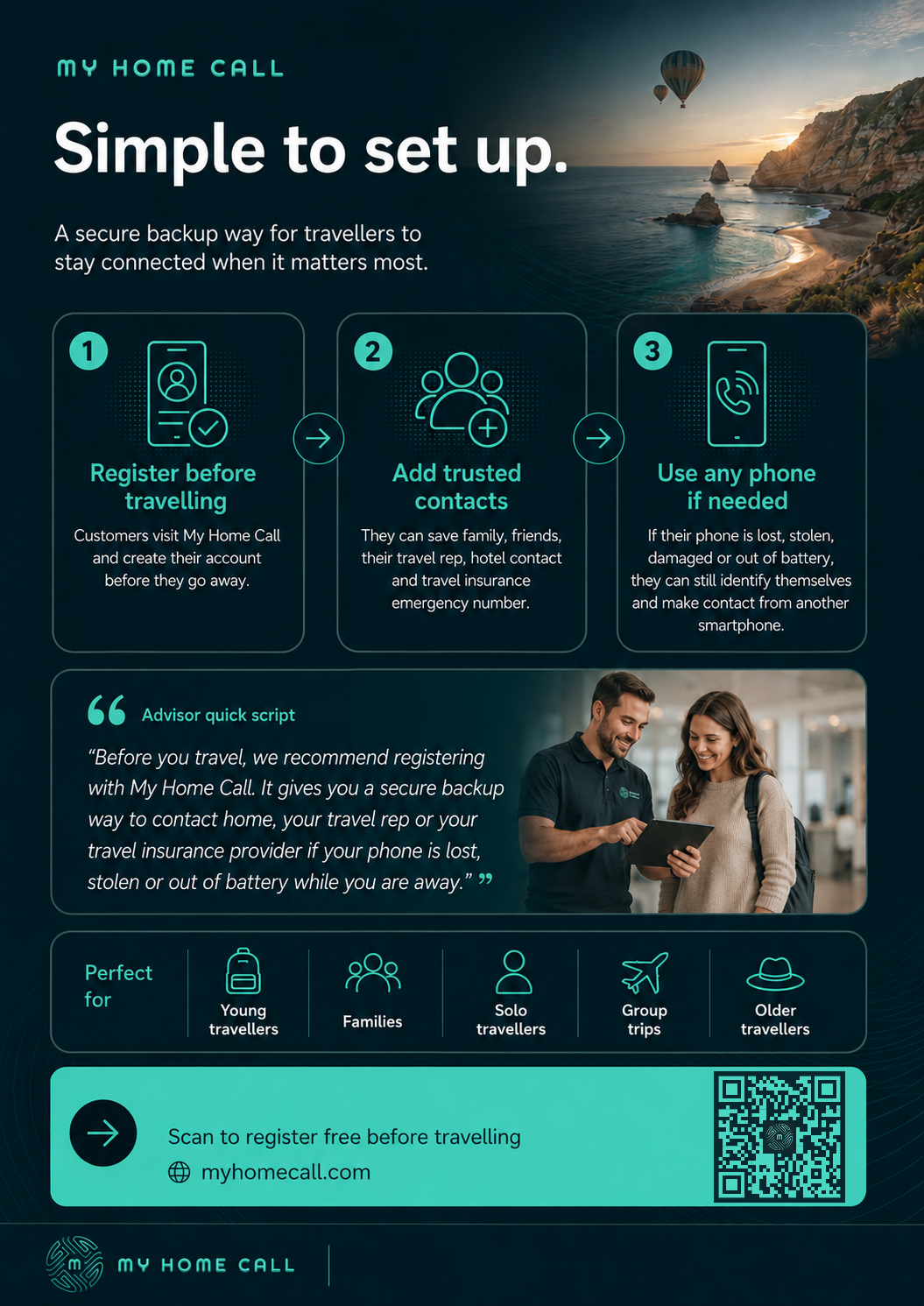
Pin it to the fridge, send it to the grandparents who are coming along, or keep it on your phone next to your boarding passes. However you use it, the goal is the same: to leave home knowing that if a phone fails, your family can still reach each other.
Set It Up Before You Go, Not After
The trips that go smoothly are rarely the ones with the most expensive kit. They are the ones where a few sensible things were sorted out in advance. Checking travel advice, sorting insurance, agreeing a meeting point and putting a contact backup in place all belong on the same short list, and all can be done before you have even left the house.
Register free before you travel and give your family one less thing to worry about this summer.
About My Home Call
My Home Call is a UK built biometric safety platform. Any registered My Home Call account holder on a free or paid plan can reach their saved contacts from any borrowed device, without needing their own phone, without remembering numbers, and without exposing personal contact details.
Because it works from any device, anywhere, My Home Call is just as valuable away from home as it is in the school day. If a child’s phone is lost, flat, forgotten or stolen at the airport, on a school trip, on a day out, or simply walking home, they can still reach a parent or trusted adult securely from any phone or tablet they can borrow.
**Get in touch to learn how My Home Call keeps your family connected: **hello@myhomecall.com