

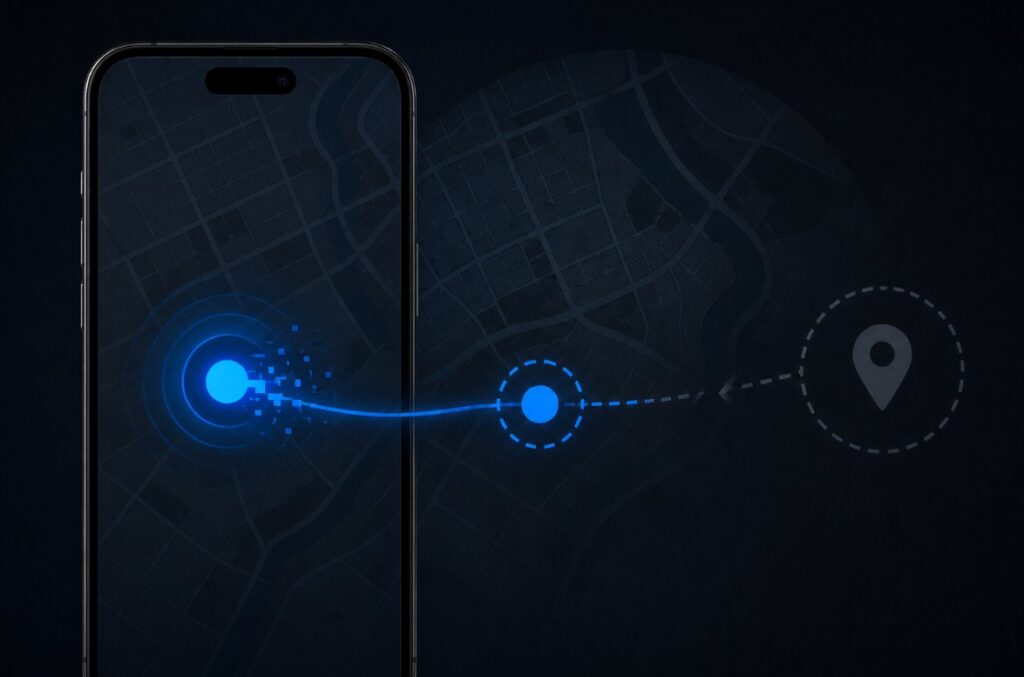
The Blue Dot Goes Out: What Happens When Your Child’s Phone Is Flat?
There is a particular kind of calm that comes from opening an app and seeing a small blue dot exactly where it should be. School. A friend’s house. The train home. The dot is there, so they are there, and you can put your phone back in your pocket and get on with your evening.
We are not going to argue with that feeling. It is real, and the apps that produce it are genuinely good at their job. But it is worth asking the question that sits directly underneath it, especially at this time of year: what happens when your child’s phone is flat?
What the apps are genuinely good at
Life360, Find My, Google Family Link and the rest do something difficult and do it well. They take a signal, place it on a map, and turn an unanswerable question into a glanceable one. For a parent whose teenager has stopped replying to messages, that is not surveillance culture run amok. That is a lot of small anxieties quietly retired.
So this is not a criticism of those apps. It is a question about their edges.
The dot is the phone
Here is the thing that is easy to forget once the reassurance becomes routine: the blue dot is not your child. The blue dot is a handset with charge in it, in an area with signal, with location sharing switched on, still in your child’s possession.
Most of the time those four conditions hold, which is exactly why we stop noticing them. We have made this case in full before, in Tracking Apps Track the Phone, Not the Person. This piece is about what happens the moment any one of those conditions fails.
Because when it does, the map does not announce it. It just shows a slightly older timestamp. The dot goes still, or grey, or vanishes. The peace of mind stops, and the question that replaces it is not “where is the phone?” It is “does my child know what to do right now?”
What happens when your child’s phone is flat
The battery is flat, or the phone is in a locked school drawer, or it went in the pool, or someone took it on a busy street. Your child is standing somewhere, possibly somewhere unfamiliar, holding nothing.
The first question is whether they can say your mobile number out loud. Not find it. Say it. For most children the honest answer is no, and it is not their fault: we covered why in Why Kids Don’t Memorise Phone Numbers Anymore.
But there is a second question, and it is the one almost nobody asks.
Do they know which number to call?
Not 999. The number where they actually are.
If your child is on a school trip this summer, or a holiday, or a first trip abroad with friends, this stops being hypothetical. And most of us assume they would work it out, because we assume we would work it out.
The good news is that there is one answer for most of the continent. 112 works across every EU country, plus the UK and several others. It is free from any phone. On most handsets it can be dialled even when the screen is locked, and even from a phone that is not theirs. The same page carries another number worth knowing: 116 000, the missing children hotline, which operates across all EU countries.
The less good news is how few people know this. The European Commission’s 2026 report on 112, analysed by the European Emergency Number Association, found that only half of Europeans know 112 can be used when travelling in another EU country. Around 30% do not know what number to call abroad at all. Awareness is climbing, which is genuinely encouraging. Half is still half.
So read that back as a parent. Half of the adults on that flight could not name the number. The teenager in seat 14C, whose battery is at 4% and whose contacts live behind a lock screen, is not going to do better.
If you are travelling this summer, our family travel safety tips cover the practical groundwork. But teach them 112 before you teach them anything else. It costs nothing and it takes ten seconds.
What is left underneath
This is the part we keep coming back to. Every layer of modern family safety, the tracking, the messaging, the check-ins, sits on one assumption: that the phone is present and working. Remove it and the whole stack comes down at once, at precisely the moment it is needed.
A safety net worth the name has to survive the loss of the thing it was built on. It cannot depend on a battery, or on a memory, or on the child happening to be holding the right object. It has to belong to the person.
That is the principle behind how My Home Call works, and it is why we have spent this month asking what a way home really requires and who should hold the key to it.
There is one more thing to say about all of this, and we will say it next week.
In the meantime, ask them for your number. Then ask them for 112.