

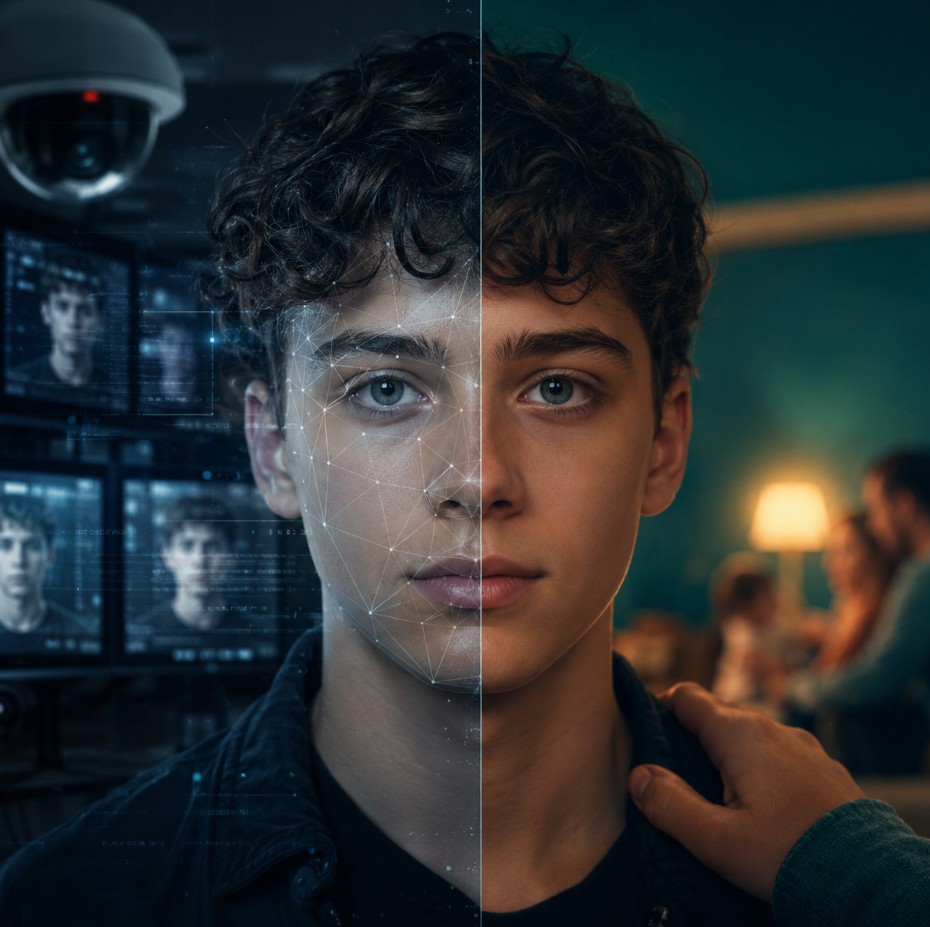
Is Facial Recognition Safe? The Same Face, Two Different Stories
Is facial recognition safe? It is a fair question to be asking this summer. In recent weeks the police have pushed live facial recognition further into British city centres, including central London. A newer approach lets an officer scan a face from a phone in the street. The Government has been consulting on a legal framework to govern all of it. If those headlines have left you uneasy, that instinct is worth listening to.
But “safe” is the wrong single word for the whole of facial recognition, because facial recognition is not one thing. The same underlying technology can be pointed at a crowd that never agreed to it, or chosen by a person to prove who they are. Those are two different stories about the same face, and telling them apart is the most useful thing anyone can do in this debate.
The version making the headlines
The facial recognition in the news is the surveillance kind. Cameras scan everyone who walks past, compare each face against a watchlist, and flag possible matches to officers nearby. It is now used by around a dozen UK police forces, with a wider rollout planned, and ministers have likened its significance to the arrival of DNA evidence. The House of Commons research service has a clear, non-partisan overview of how police use the technology if you want the detail.
The concerns are real. People are identified without being asked, in public places they cannot easily avoid, against databases they had no say in. Around two thirds of the public support police use of the technology and roughly one in ten oppose it, which tells you this is contested rather than settled. Campaigners are right to press for stronger rules, and we have said before that a good deal of that scepticism is healthy.
The version you would actually choose
Now picture the opposite. You unlock your phone with your face. You walk through an e-passport gate that you chose to use. In each case you decided to enrol, you know exactly what is being checked and why, and nothing happens unless you begin it. The regulator draws the same line: the ICO’s guidance on biometric recognition points out that an everyday use like unlocking a phone is a one to one check, where the individual takes part directly and knows how their data is being used.
That is a different relationship with the technology, not a different setting on the same dial. In the first story, the technology is used on you. In the second, it is used by you. We set out the full version of that argument in an earlier piece on consensual biometrics and surveillance, and it comes down to this: the test is not whether a face is being read, but who decided it should be, who benefits, and who stays in control.
So, is facial recognition safe?
Here is where it meets the question we opened this month with: how do you reach home without a phone?
Answer that honestly and you walk straight into biometrics, because the hard part is not sending a message. It is proving, on a borrowed or unfamiliar device, that you are really you. A child whose phone is lost at a festival. A teenager whose battery died on the way home. A pupil at one of the many schools that, since Section 36 of the Children’s Wellbeing and Schools Act came into force on 29 June, are phone free by law for the whole day. In each case the device is gone, but the person is still standing there, still needing to reach someone who loves them.
A face used the surveillance way takes something from a person: the freedom to move through the world unwatched. A face used the consensual way gives something back: the ability to be yourself, and reach your people, on any device within arm’s reach. Same technology, opposite purpose. That second use is how My Home Call works, and it is why we are comfortable building on biometrics at a moment when so much of the news makes people wary of them.
So when the next headline about facial recognition lands, ask a sharper question than whether it is safe. Ask who is holding it, and which way it is pointing. Pointed at a crowd, it watches. Handed to a person, it can be the difference between being stranded and being on the way home.
There is a second half to this, though. Even when a family does reach for technology to stay connected, most of the tools on the market are quietly solving the wrong problem. That is where we are heading next.
About My Home Call (optional closing block, matches your other posts)
My Home Call is a UK-built biometric safety platform. Any registered account holder, on a free or paid plan, can reach their saved contacts from any borrowed device, without needing their own phone, without remembering numbers, and without exposing personal contact details. It works wherever another device is within reach, giving children and families a secure way to reach home when their own phone is lost, flat, forgotten, or simply not allowed.