

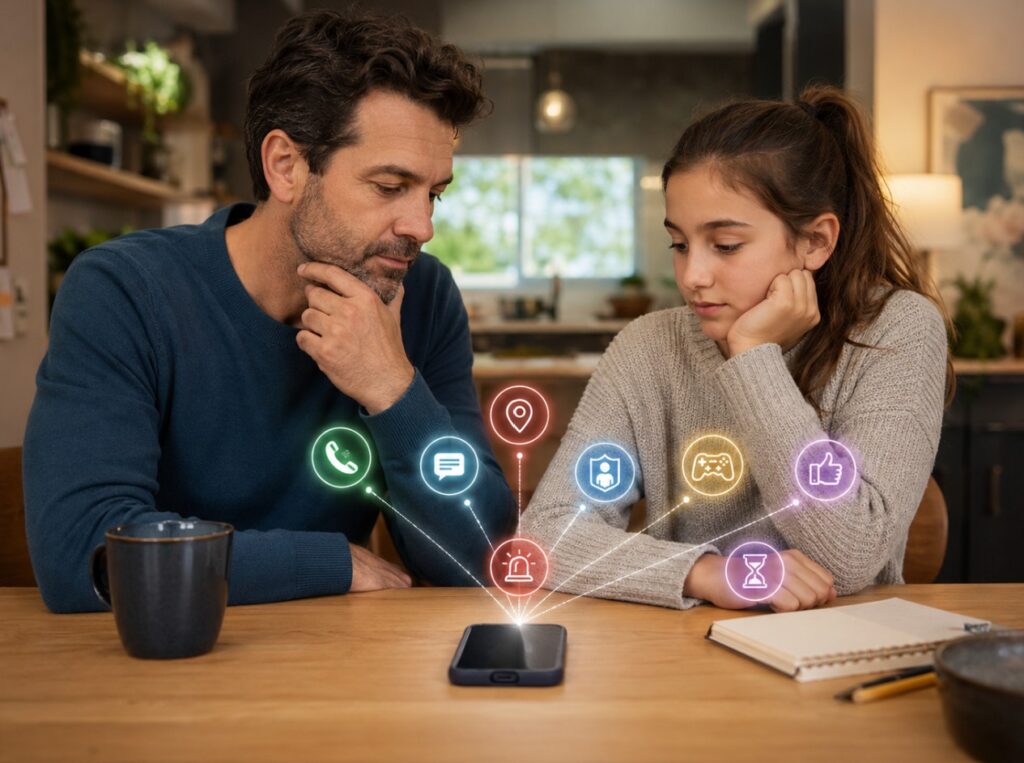
First Phone Debate
The First Phone Debate: When Should You Get Your Child a Phone?
Few decisions in modern parenting are as quietly stressful as the first phone. Too early and you have signed your child up to all the harms of the internet before they can navigate any of them. Too late and they are the only one in their friendship group without one, missing the group chats, the plans, the social glue of secondary school life.
It is no surprise that parents agonise over it. The default answer used to be “probably around eleven, when secondary school starts.” That default is now being seriously questioned by parents, by schools, and by movements like Smartphone Free Childhood, who have helped tens of thousands of families delay the first phone together.
This is a good conversation to be having. But we think most families approach it from slightly the wrong angle. Before asking when to give a child their first phone, it is worth asking what we want the phone to do.
The Three Things a First Phone Is Really For
Strip away the social pressure and most parents want a first phone to do three things.
Safety.
So, a child can reach a parent or trusted adult when something goes wrong. Late buses, changes of plan, a friend’s house that turned out not to be where they expected, missing a meet-up.
Connection.
So, a child stays in touch with friends and family and is not the only one excluded from the social fabric of their year group.
Independence.
So, a child gradually learns to manage their own time, their own plans, and their own communication, in the same way they learn to ride a bike or take public transport.
All three of these are reasonable things to want. None of them, on their own, requires a fully unrestricted smartphone with social media and an app store.
The Decision Hidden Inside the Decision
Here is the part that often gets skipped. Parents tend to ask, “when should we get them a phone?” when the more useful question is “which of those three things do we need to solve, and in what order?”
A primary school child rarely needs connection or independence in any meaningful sense. They need safety. A clear way to reach a parent if something goes wrong on the walk home, at after-school club, or at a friend’s house.
A teenager moving up to secondary school may need a degree of independence and a way to coordinate with friends, but the connection they want is usually with a small group of people they already know, not the global social media audience that comes packaged in by default.
By the time a young person is approaching the end of secondary school, they probably do need something close to a full smartphone, ideally introduced gradually with proper conversation about how to use it well.
Once you separate the three needs, the question stops being “when do they get a phone” and becomes “what is the right tool for what they need right now.”
The Smartphone Was Never the Only Option
It is striking how completely the smartphone has come to dominate the conversation. A generation ago, children had a wide range of options, from a payphone to a basic mobile to a family landline. Today, the default assumption is that “getting a phone” means getting a device with an internet browser, a camera, an app store and access to every social platform in existence.
That assumption is starting to break down. Brick phones and minimal devices are coming back into fashion, often marketed explicitly at parents who want to give safety and basic communication without the rest. Schools are increasingly relaxed about, or even supportive of, simple devices.
Beyond the device itself, there are other ways to give a child a safe line to home that do not require any phone at all. A kiosk in a school. A trusted adult in every place a child regularly goes. A platform that lets a child reach a parent from any borrowed device when they need to. Solving for safety does not have to start with a smartphone in a child’s pocket.
How to Think About the Decision
If you are weighing up a first phone right now, a few questions might help.
What problem are we actually solving?
Be specific. Walking home from school? Coordinating with a friendship group? Keeping in touch on a Saturday? Different problems have different right answers.
Could a simpler device solve it?
A basic mobile, a smartwatch with calling, a brick phone, a shared family device. The full smartphone is rarely the only option.
What would the worst outcome look like?
Not the worst headline, the worst realistic outcome. Endless scrolling? Group chat drama? Sleep loss? You can design around these once you have named them.
Who else in your child’s year group is doing what?
Not because you should follow the crowd, but because the social dynamics around being the only one without a phone are real and worth taking seriously. The good news is that more parents than ever are delaying, and a coordinated approach across a year group works far better than going it alone.
What is the backup plan if the chosen device fails?
Phones get lost, stolen, broken and flat. A child’s safety should not depend on a single device working perfectly. A backup route to a trusted adult is worth having from day one.
There Is No Single Right Answer
Every child is different. Every family is different. Some children are ready for more responsibility at ten. Others are still finding their feet with a basic mobile at fourteen. The most useful thing a parent can do is approach this decision deliberately, rather than letting the default carry them along.
And the most reassuring thing to know is that the decision is not actually one decision. It is a series of small steps, taken over years, that can be adjusted as a child grows and as circumstances change. The first phone is not the last conversation. It is the start of a long one.
Where My Home Call Fits
My Home Call is a biometric safety platform that lets a registered account holder reach their saved contacts from any borrowed device. For families navigating the first phone decision, that matters in two ways.
First, it means safety does not have to drive the timing of a smartphone. A child can have a reliable way to reach a parent in an emergency without owning a full-featured phone of their own.
Second, once a child does have a phone, it acts as a backup for the moments the phone is not where it should be. Whichever path a family takes on the first phone debate, the underlying need, that a child can always reach a trusted adult, is still met.
About My Home Call
My Home Call is a UK-built biometric safety platform. Any registered account holder, on a free or paid plan, can reach their saved contacts from any borrowed device, without needing their own phone, without remembering numbers, and without exposing personal contact details. Messages are sent as a text directly to the contact’s mobile, so there is no app for the person receiving the message to download.
It works wherever another device is within reach, giving children and families a secure way to reach home when their own phone is lost, flat, forgotten, or simply not allowed.
👉 To learn how My Home Call supports the first phone decision, get in touch: hello@myhomecall.com