

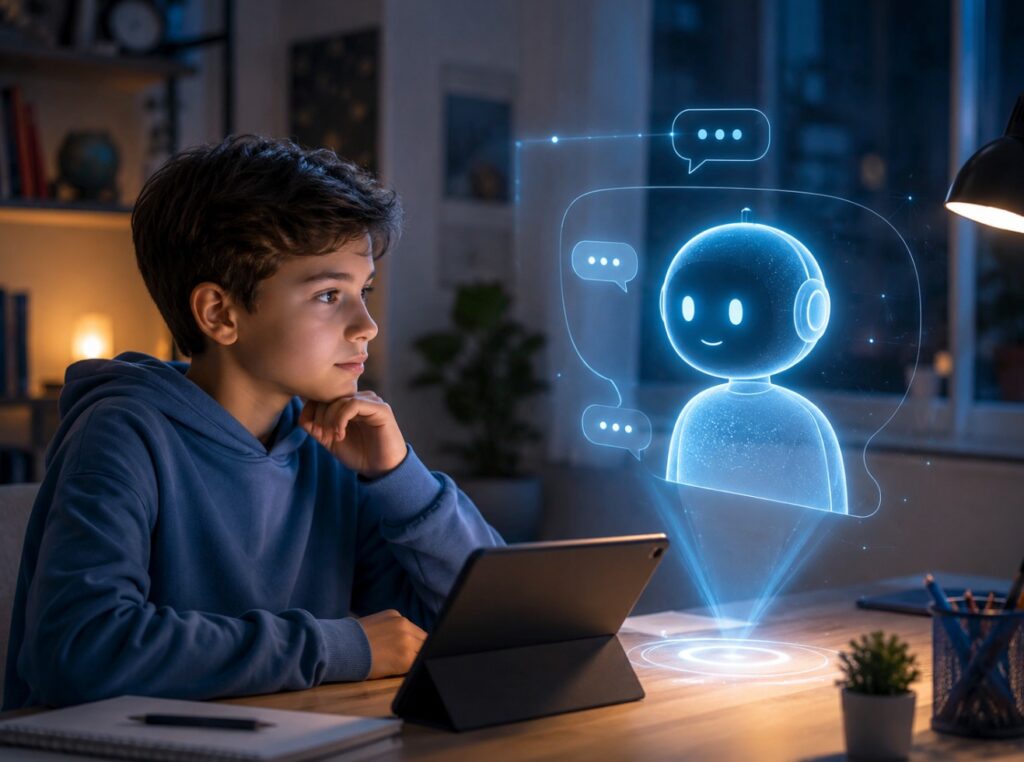
AI Chatbots and Children
Most of the national conversation about online safety still focuses on social media. That is understandable, since it is the area with the longest track record of harm and the clearest evidence base.
But quietly, something else has been happening. AI chatbots have moved from novelty to daily companion for a meaningful number of young people, and the early evidence is starting to give experts pause. A recent UK study with more than a thousand boys aged 12 to 16 raised real concerns about companionship, emotional reliance and the role these systems are coming to play in children’s inner lives.
This is not a moral panic moment. It is a moment to pay attention, learn what is actually going on, and start the kind of calm, useful conversation with our children that has always done the most good.
What Are We Actually Talking About
AI chatbots are conversational systems that respond in natural language, often with a name, a personality, and a tone designed to feel warm and engaging. Some are general assistants. Many, particularly the ones gaining traction with younger users, are explicitly designed as companions, friends, or confidants.
They are available free or cheaply, work on any phone, and remember previous conversations. For a lonely or curious child, that is a powerful combination. The chatbot is always there, always patient, never bored, never busy, and never judgemental. It is easy to see the appeal.
It is also easy to see how, used too much, that appeal becomes a problem.
Why Researchers Are Concerned
The concerns being raised by researchers and online safety specialists fall into a few clear categories.
Emotional reliance.
A chatbot that is always available and always responsive can quietly replace the harder, riskier business of building real human relationships. For a child who is lonely or struggling socially, that substitution can feel like progress when it is actually withdrawal.
Confused emotional learning.
Healthy relationships involve friction, disagreement, repair and the experience of being held to account by someone who cares about you. A chatbot rarely provides any of these. A child whose primary emotional outlet is an agreeable AI may have less practice with the real skills of human connection.
Inappropriate advice or content.
Some chatbot products have been shown to give children advice on subjects ranging from relationships to mental health that would not pass a reasonable safeguarding test if offered by an adult.
Privacy and data.
Children share remarkably personal things with chatbots, often more than they would tell a parent or teacher. Where that data goes, who can see it, and how it might be used in future is rarely something a young user has thought through.
Distorted expectations.
A child who learns that another “person” is always available, always agreeable and always interested may carry those expectations into human relationships that do not, and should not, work the same way.
What This Is Not
It is worth being honest about what the evidence does and does not support. AI chatbots are not all harmful. Many young people use them sensibly, for homework help, language practice, creative writing, or just messing about. The technology has real benefits, and some of those benefits are particularly valuable for children with additional needs.
The concern is not that the tools exist. It is that, as with social media a decade ago, the products are being adopted by children far faster than the public conversation about them has caught up.
What Parents Can Helpfully Do
If your child is using AI chatbots, or might soon be, a few small things will go a long way.
Find out what they are using and try it yourself.
The single most useful thing any parent can do is have a working knowledge of the apps their children spend time on. Spend ten minutes with the chatbot. Get a sense of its tone, its limits and how it responds to the kinds of questions a young person might ask.
Talk about what a chatbot is and is not.
Children often understand intellectually that they are talking to a program, but emotionally treat it as a person. A simple, age-appropriate conversation about how these systems actually work, that they predict words rather than understand feelings, can recalibrate their relationship with the tool.
Watch for substitution rather than addition.
Using a chatbot alongside friends, sport, school, family time and outdoor play is very different from using a chatbot instead of any of those things. If a child’s chatbot use is replacing human interaction rather than supplementing it, that is the signal worth acting on.
Make it easy to reach you.
One reason children turn to AI companions is that they feel they have no one else available. The single most powerful counterweight is being a trusted adult who is reachable, present and willing to listen without judgement. This is not about surveillance. It is about being the obvious first person a child thinks of when they want to talk.
Keep checking in.
As with everything in this space, the technology will keep changing. The conversation has to be ongoing, not a single sit-down chat. Small, regular check-ins are far more effective than occasional formal ones.
The Familiar Lesson, in a New Form
Every wave of new technology in children’s lives, from television to social media to AI chatbots, has produced the same underlying lesson. Tools shape behaviour, design matters, and the most important protective factor is a trusted adult who is paying attention.
AI chatbots are not the next moral panic. They are a real technology with real benefits and real risks, and they deserve to be understood properly before they are either banned or embraced. The families that handle them best will be the ones that engage early, talk often, and stay close.
About My Home Call
My Home Call is a UK-built biometric safety platform. Any registered account holder, on a free or paid plan, can reach their saved contacts from any borrowed device, without needing their own phone, without remembering numbers, and without exposing personal contact details. Messages are sent as a text directly to the contact’s mobile, so there is no app for the person receiving the message to download.
It works wherever another device is within reach, giving children and families a secure way to reach home when their own phone is lost, flat, forgotten, or simply not allowed.