

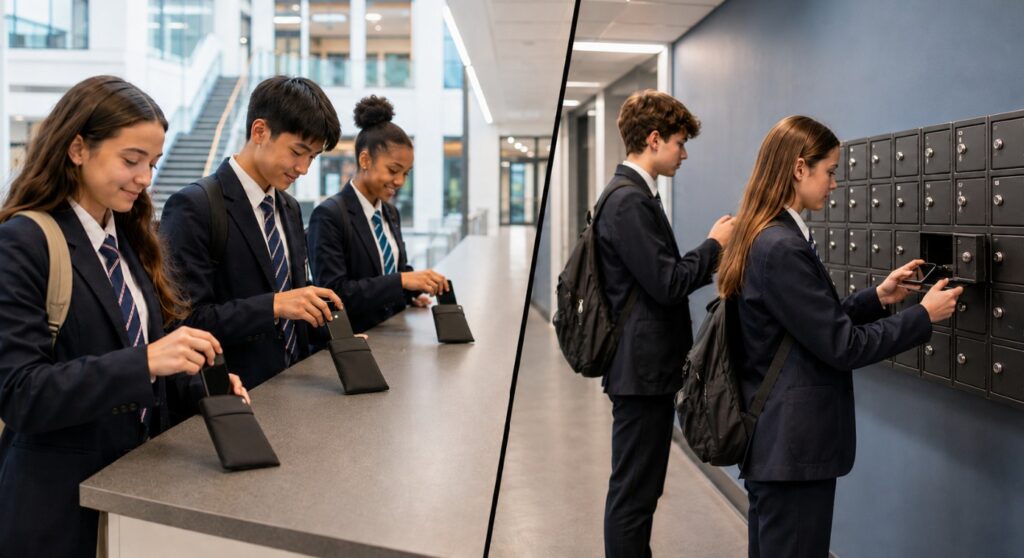
Phone Pouches vs Lockers for Phone Free Schools
For most school leaders, the phone question is no longer whether. It is how.
From 29 June 2026, Section 36 of the Children’s Wellbeing and Schools Act 2026 gives the Department for Education’s mobile phone guidance the force of law. The default expectation is clear: schools should be mobile phone free environments, with anything else by exception only. Ofsted will assess phone policies at every inspection.
The safeguarding case behind it is settled. Restricting phones during the school day reduces cyberbullying, social media misuse, coercion and the spread of non-consensual images. These are not fringe issues. They are daily realities for pastoral teams across the country, and the direction of travel is no longer in doubt.
So the live question for most leaders is not whether to go phone free. It is how to store the phones once they do. Two routes dominate, and on cost to the school they could hardly be more different.
The Two Routes Schools Are Weighing Up
Magnetic and Faraday pouches are quick to roll out. The pupil carries a locked bag holding their phone. The trade-off is cost and admin. On a worked example for an 1,100-pupil school split across two buildings, year one lands between £17,700 and £47,500 once you add unlocking stations, software and staff training. After that, budget £3,000 to £4,500 every year for replacing pouches and equipping each new Year 7 intake. That cost sits on the school budget indefinitely, and there is a daily bottleneck at the gates as hundreds of pupils lock and unlock.
There is also a quieter problem. A pouch only works if the pupil brings it, remembers it, and keeps it intact. In practice, many do not:
- Pouches are forgotten at home
- They are left in lockers or lost entirely
- They get damaged through daily wear
- Each one is another exception for staff to chase down at the gate
The scale can be eye-opening. Some of the schools we have spoken to have recorded over 2,000 cases of forgotten pouches in a single term. That is not an edge case. That is a daily queue, and a daily drain on staff time.
Managed lockers work on a different model. A provider installs and maintains keyless lockers at no cost to the school, funded instead by a small annual rental fee paid by parents per slot. Upfront cost to the school is zero, and ongoing maintenance cost to the school is zero. The main considerations are wall space and making sure lower-income families are not disadvantaged, which schools usually handle by subsidising a portion of slots.
On the school budget alone, the comparison is stark. Pouches cost the school £17,700 to £47,500 in year one and keep costing every year after. Managed lockers cost the school nothing to install and nothing to run. Both routes are legitimate, and the right fit depends on a school’s space, layout and culture. But if the question is purely financial, lockers win comfortably.
The Problem Both Routes Share
Here is what neither pouches nor lockers solve, because it was never their job to.
When the phone leaves the pupil’s hand, the everyday reasons they used it do not disappear. They are simply redirected. And in a phone free school they nearly all land in the same place: the front office.
- Topping up lunch money
- A forgotten PE kit or lunch
- Running late, or missing the bus
- A change to collection arrangements
- A detention that moves the pickup time
Each of these used to be a quick text. Now it is a pupil at reception, a member of staff relaying the message, and a parent contacted by hand. Multiply that across a thousand pupils over a full school week, and a safeguarding win turns into a steady operational drag on the very staff the policy was meant to free up.
This is not a flaw in pouches or lockers. It is a missing piece. Storage handles the phone. It does not handle the communication the phone was quietly doing.
The Missing Piece: A Route Home That Bypasses Reception
If phone free schools are to work long term, restriction alone is not enough. Schools need a way to replace what phones were being used for: simple, everyday contact between pupil and home.
A pupil goes to a secure kiosk, verifies their identity with a quick facial scan, and sends a pre-set message to a trusted contact at home. The parent is notified instantly. No personal device. No pouch to unlock. No member of staff pulled into the loop. The contrast is simple. Without it, a pupil tells a teacher, is sent to reception, and a staff member relays the message and contacts the parent by hand. With it, the pupil goes to the kiosk between lessons, and the message reaches home with zero staff involvement.
The kiosk is deliberately narrow in what it can do. It is a locked-down tablet with no SIM and no calling. It allows pre-written messages only, with no free text, no social media, no internet browsing and no public display of phone numbers. Contact routing is encrypted throughout. It supports the phone free policy rather than poking a hole in it. The person, not the device, becomes the key to staying in touch.
Phone Pouches vs Lockers: Questions School Leaders Ask
Are phone pouches or lockers better for schools?
Both are legitimate, and the right fit depends on a school’s space, layout and culture. On cost to the school, managed lockers are hard to beat: a provider installs and runs them at no cost to the school, while pouches carry a year-one cost of roughly £17,700 to £47,500 plus recurring annual spend. Neither, on its own, replaces the everyday contact pupils used their phones for.
Do schools have to store phones under Section 36?
From 29 June 2026, Section 36 of the Children’s Wellbeing and Schools Act 2026 gives the Department for Education’s mobile phone guidance the force of law. The default expectation is mobile phone free environments, with exceptions only, and Ofsted will assess phone policies at inspection.
How do pupils contact home in a phone free school?
A secure kiosk gives pupils a route that bypasses reception. A pupil verifies their identity with a facial scan and sends a pre-written message to a trusted contact at home, who is notified by text. There is no SIM, no calling and no staff member pulled into the loop, so storage and communication are both handled without reopening the policy.
Where My Home Call Fits
My Home Call is built to sit alongside your phone storage, not to replace it. Whichever route a school picks, pouches or lockers, the kiosk closes the same gap: it takes everyday pupil-to-home communication off the front office and gives it a secure, controlled route of its own.
Pouches and lockers both store the phone well, and on cost to the school, managed lockers are hard to beat. Storing the phone, though, is only half the job. Remove the everyday reason a child needs a phone in school, without a phone and without the office, and the policy becomes something parents back rather than worry about. Phone free starts working for everyone.
About My Home Call
My Home Call is a UK-built biometric safety platform. Any registered account holder, on a free or paid plan, can reach their saved contacts from any borrowed device, without needing their own phone, without remembering numbers, and without exposing personal contact details. Messages are sent as a text directly to the contact’s mobile, so there is no app for the person receiving the message to download.
It works wherever another device is within reach, giving children and families a secure way to reach home when their own phone is lost, flat, forgotten, or simply not allowed.
👉 To see how My Home Call fits alongside your phone pouches or lockers, get in touch: hello@myhomecall.com