

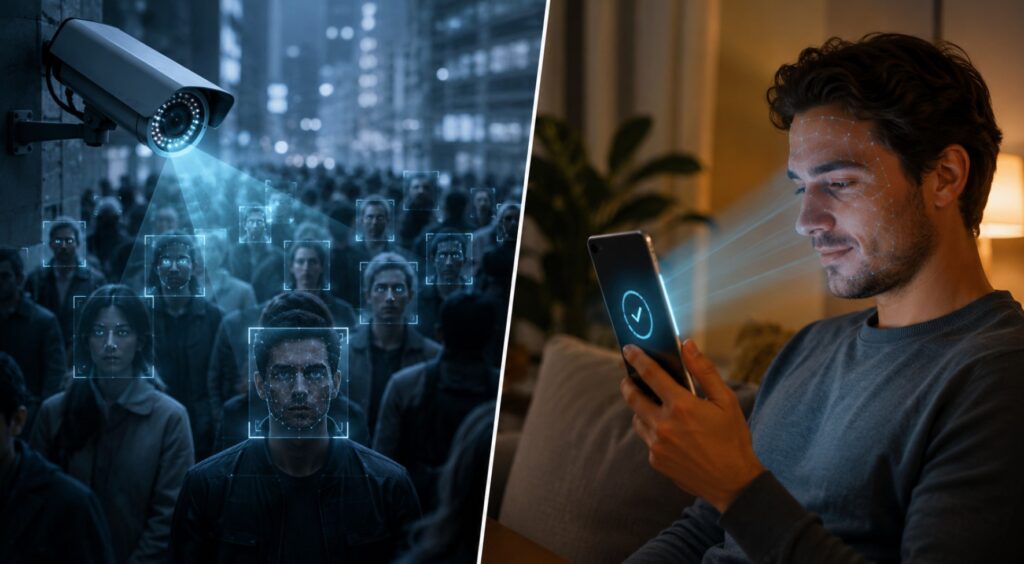
Consensual Biometrics vs Surveillance
Facial recognition has been having a difficult year in the UK news. Police use of live facial recognition in city centres has been challenged by civil liberties groups. High street retailers using the technology to identify suspected shoplifters have faced criticism over accuracy. The EU’s AI Act has set new rules on biometric systems. The conversation, on the whole, is sceptical, and we think that scepticism is largely healthy.
But there is a risk in the current debate of treating all facial recognition as one undifferentiated category. It is not. The most important distinction in this entire field is one rarely made clearly in the headlines: the difference between biometric identification used with someone’s consent, on their own terms, and biometric surveillance used on them without their knowledge or active agreement.
Those two things are not the same technology in different uses. They are, in any meaningful ethical or practical sense, two different products. The distinction between consensual biometrics and biometric surveillance gets a lot clearer when you separate them.
What Surveillance Looks Like
The use cases driving most of the public concern share a set of features.
- People are identified without being asked
- Identification happens in a public space, often a high street, station or shopping centre
- The data being matched against has been collected by an authority or company without the individual’s input
- The person being identified often has no idea it is happening
- The purpose is enforcement, exclusion, or risk-scoring of the individual
These are the cases where civil liberties concerns are most serious and most legitimate. They raise real questions about due process, about accuracy, about bias, and about the kind of public spaces we want to live in. We think those debates need to happen, and the public is right to be cautious.
What Consensual Identification Looks Like
Now consider a completely different kind of biometric use, with a completely different set of features.
- The individual chooses to register, knowing exactly what is being captured and why
- Identification only happens at the individual’s own initiative, when they decide to use the system
- The biometric data is used only to confirm that the person is who they say they are
- The purpose is to give the individual a capability they otherwise would not have
- There is no surveillance, no monitoring, no continuous collection, and no third party scoring or excluding anyone
This is the model behind unlocking a phone with a face scan. It is the model behind biometric checks at e-passport gates that travellers actively choose to use. And it is the model behind My Home Call.
The relationship between the person and the technology is completely different. In the surveillance model, the technology is used on them. In the consensual model, the technology is used by them.
Why Consent Changes Everything
Some people object to that distinction. “You are still using my face,” the argument goes, “and my face is biometric data either way.”
It is a fair point worth answering directly. The thing that changes with consent is not the technology, but the relationship of power. In surveillance, the individual has no say in whether their face is read, no insight into what is done with the result, and no remedy if it goes wrong. In consensual identification, the individual chose to enrol, can stop using the system at any time, can have their data deleted, and is the only one who initiates the action.
These are not minor procedural differences. They are the entire substance of what we mean when we talk about ethical use of personal data. A system designed around the individual’s choice and benefit is fundamentally different from a system that operates regardless of either.
Why This Matters for Safety Products
Biometric identification is one of the most powerful tools available for solving the central problem in personal safety: how do you let someone prove they are themselves, without them having to carry a particular device?
That problem has real-world consequences. A child whose phone is lost or stolen, an elderly relative who has forgotten their wallet, an adult away from home with no documents on them. In each case, the question is not “what does the device know?” but who is this person, and how can they reach someone who can help?
Done badly, biometric identification can be intrusive and unsafe. Done well, with proper consent, transparency and minimum data collection, it can give people back a capability the smartphone era quietly took away. The ability to be yourself, anywhere, without needing a particular device in your hand.
It is worth getting that distinction right in the public conversation. Lumping all biometrics into the same category as live facial recognition in public spaces does a disservice both to the cause of civil liberties, and to the people who could benefit from carefully designed, consent-based safety tools.
Where We Stand
We believe the scepticism currently being applied to facial recognition in public spaces is warranted, and the regulators and campaigners pushing for stronger rules are doing important work.
We also believe that consent-based biometric identification, where the individual chooses to enrol, controls their own data, and uses the system entirely on their own terms, is a genuinely useful technology that should not be tarred with the same brush.
The test is not whether biometric data is being processed. The test is who decided that it should be, who benefits from it, and who is in control.
Consensual Biometrics vs Surveillance: Questions People Ask
Is facial recognition the same as surveillance?
No. The technology can look similar, but the relationship of power is the opposite. Surveillance reads a face without the person’s say-so, for enforcement or exclusion. Consensual identification only runs when the individual chooses to use it, to confirm they are who they say they are. The test is who decided it should happen, who benefits, and who is in control.
What is consensual biometric identification?
It is a model where the individual chooses to register, knowing exactly what is captured and why, and identification happens only at their own initiative. The data is used only to confirm identity, with no monitoring, no continuous collection and no third party scoring anyone. Unlocking a phone with a face scan and e-passport gates work this way, and so does My Home Call.
Is My Home Call’s facial recognition private?
My Home Call is built entirely on the consensual model. The biometric check happens only when the individual decides to reach home from a borrowed device. There is no continuous monitoring, no third-party identification and no shared database, and an account holder can leave the service or have their data deleted at any time.
Where My Home Call Fits
My Home Call is built entirely on the consensual model. A parent or account holder chooses to register, controls their own profile, sets the trusted contacts that messages can be sent to, and can leave the service or have data deleted at any time. The biometric check happens only when the individual themselves goes to a borrowed device and decides to reach home. There is no continuous monitoring, no third-party identification, and no shared database with anyone else.
That is the difference between using a face to give a person a voice, and using a face to take theirs away.
About My Home Call
My Home Call is a UK-built biometric safety platform. Any registered account holder, on a free or paid plan, can reach their saved contacts from any borrowed device, without needing their own phone, without remembering numbers, and without exposing personal contact details. Messages are sent as a text directly to the contact’s mobile, so there is no app for the person receiving the message to download.
It works wherever another device is within reach, giving children and families a secure way to reach home when their own phone is lost, flat, forgotten, or simply not allowed.